I
Conditioning
Xiu Shen · conditioning
Strengthening the body so that it can hold a posture without complaint. Standing, alignment, ordinary stamina — built slowly, without strain.
Read onThree practices, in order, and no ceremony around them. Conditioning the body, quieting the noise, and then the work itself — seated stillness, where attention turns around and looks at what has been running the show.
The first two are preparation. The third is the work. Most people discover this the hard way: they sit down first, find that the body aches and the mind will not stop talking, and conclude that seated practice is not for them.
Strengthening the body so that it can hold a posture without complaint. Standing, alignment, ordinary stamina — built slowly, without strain.
Read onRemoving the chatter. Natural breathing, unhurried attention, and the discipline of not following every thought that arrives.
Read onSitting until the mind settles into stillness — and then using that stillness to look at yourself honestly, and to break the pattern you keep repeating.
Why this is the centre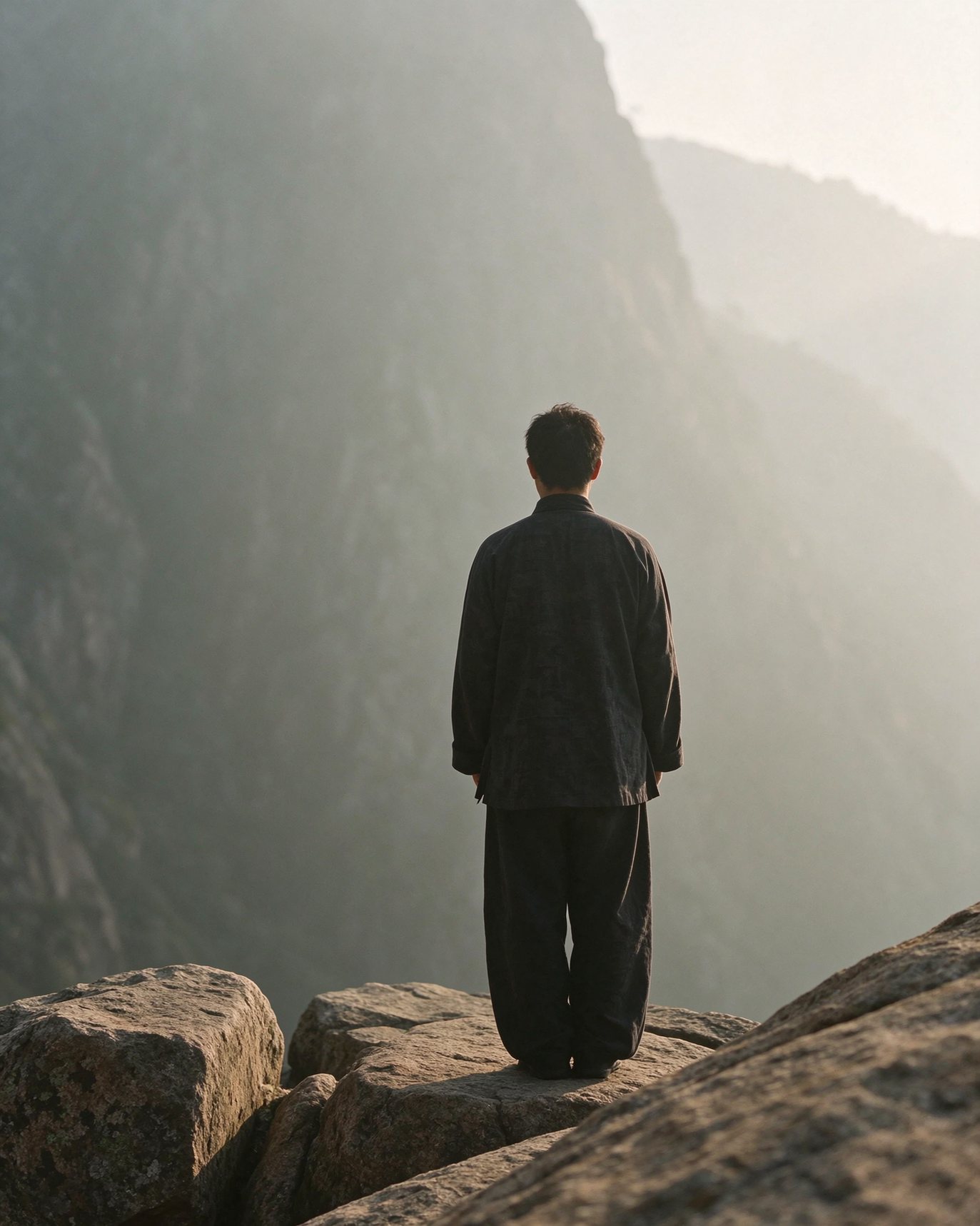
It sounds obvious and is almost always skipped. Seated practice asks the hips, knees and lower back to hold a position for twenty minutes; it asks the breath to be unobstructed. If those are not ready, every session becomes a negotiation with discomfort, and attention never gets a chance to turn inward.
So: a few weeks of standing and ordinary movement first. Not fitness, not performance — just enough that sitting is unremarkable.
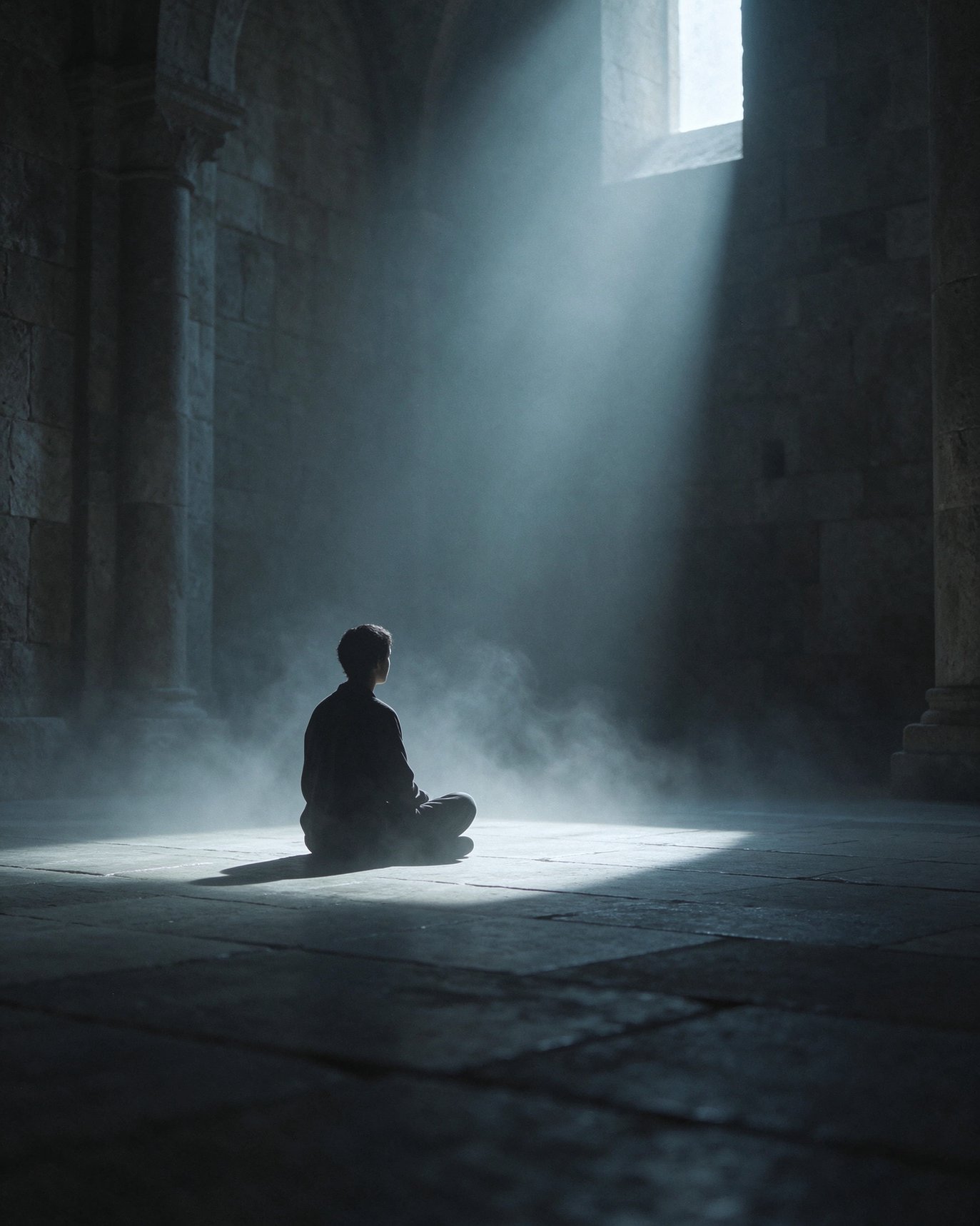
Everything before this is preparation. Seated practice is not relaxation, and it is not a technique for feeling better — it is the deliberate act of sitting down with yourself until the noise stops long enough for you to see what is underneath it.
Stillness is not a trance. It is the point at which attention stays where you put it, without being dragged away. From there, the work becomes honest: observing the pattern you repeat, and choosing against it once — which is what breaking through actually means.
The body stops adjusting, the breath finds its own rhythm, the commentary thins out. Ten to twenty minutes in.
Attention rests where it is placed. Not empty, not special — simply no longer scattered. This is the centre of the practice.
In that stillness, look at the recurring thought, the recurring reaction, the recurring excuse. See it clearly, without arguing with it.
One honest seeing, acted on once, in ordinary life. Not an insight you remember — a behaviour that changes.
“The journey of a thousand li begins beneath one’s feet.”Daodejing · chapter 64
The proportions matter. Most of the time is given to the seated practice; the rest exists only to make it possible.
Standing posture, quiet, no adjusting. Warm the body and settle the weight.
Natural breath, no counting. Let the rhythm slow without forcing it.
The centre of the session. Sit until the mind stops negotiating, then look.
The workOne sentence in a notebook: what you saw. Then stop thinking about it.
A short PDF: the seated posture, how to sit through the first twenty minutes without fidgeting, the difference between settling and stillness, and the three mistakes that keep people stuck at relaxation. Sent once.
Or read it all on the siteOne email. One PDF. Nothing else.
Used only to send the notes. Unsubscribe in one click. See the privacy note.
True Tao Practice (真道修习) publishes a free, self-directed study of body, breath and seated stillness — written for people who want the work itself, without ceremony or a membership to sell.
A free study of three practices in a fixed order: conditioning the body, clearing the mind, and seated stillness. The third is the centre — the first two exist to make it possible.
Everything is published openly. There is no members' area, no tier above this one, no ceremony at the end, and nothing for sale. If it helps, use it. If not, close the tab without guilt.
Most people who give up on seated practice give up in the first week, for two reasons that have nothing to do with meditation: their body cannot hold the posture comfortably, and their mind has never been asked to be quiet for twenty minutes without distraction.
So the body is conditioned first, briefly and gently. Then attention is trained on something simple — breath, standing, walking. Only then does the sitting begin, and only then does it have a chance of going anywhere.
The word ding is often translated as concentration, which is misleading. It is closer to settled — attention that is no longer being pulled. It is not a trance, not a blank state, and not a mark of progress. It is the ordinary condition in which a person can finally look at themselves without flinching.
What follows from that, we call breaking through: not an insight you remember fondly, but a pattern you stop repeating once, in ordinary life. That is the only result this practice claims.
Because the material is still being tested, and a paywall would make it harder to find out whether it works. Later there may be printed booklets or in-person sessions; if so, they will be announced here rather than sold through pressure.
One address, answered by a person: zhen.connect@gmail.com.
The older texts are not uniform: some of it is observation, some poetry, some the opinion of one person eight centuries ago. Flattening that into certainty would be dishonest, so we don't.
Read the practices
Condition the body. Clear the noise. Then sit. Each page gives the posture, the timing, the errors, and the source.
The foundation, and the part everyone skips. You stand, roughly shoulder-width, knees soft, arms held as if around a large barrel. Then you do nothing else for five to twenty minutes.
The work is not in the posture but in refusing to fidget with it. Weight settles, the lower back learns to hold itself, and by the third week sitting on the floor stops being an argument.
Attention trained on something too simple to be interesting: the breath, the weight of the feet, the sound of a room. The point is not to stop thoughts but to stop obeying them.
Do this while standing, walking, or waiting for water to boil. Ten minutes of this done daily for two weeks changes what happens when you finally sit down.
Sit cross-legged on a cushion, or on a chair with the feet flat. Spine upright, not rigid. Hands resting. Eyes soft, half-closed or closed. Then stay.
The first ten minutes are usually unpleasant: the body complains, the mind produces an urgent list of things to do. Do not act on any of it. Twenty minutes is the working minimum; forty is generous; two hours is for people with more time than most of us.
Long sitting can aggravate existing knee, hip or back problems; standing for long periods can do the same. Seated practice can also bring up difficult material for some people. Neither is a reason to avoid the practices, but both are reasons to be sensible: start short, stop when something hurts, and speak to a doctor if you have a condition.
This is traditional training taught for study. It is not a treatment, and this site makes no claim that it will improve any medical condition.
Including the ones about belief, money, and what happens if sitting turns out not to be for you.
One address, answered by whoever is at the desk: zhen.connect@gmail.com. No ticketing system, no sales sequence.
Send an emailSeated posture, the first twenty minutes, and settling versus stillness.
Used only to send the notes. One click to unsubscribe.
Last updated 24 November 2026. Short, because there is very little to say.
An email address, if you ask for the field notes. Nothing else is requested, and no account is created.
Ordinary technical data — page views, approximate region, device type — through analytics and, where advertising is used, advertising measurement tools.
Analytics and advertising measurement cookies may be set. You can block or delete them in your browser at any time and the site keeps working. Where the law requires consent, it is asked for before advertising cookies are set.
Email delivery, hosting and analytics are handled by service providers acting on our instructions. Nothing is sold, and nothing is shared for anyone else's marketing.
You may ask to see, correct or delete what we hold, and withdraw consent at any time. Every email has a one-click unsubscribe. Requests are answered within thirty days.
Check your inbox in the next few minutes. If nothing arrives, look in promotions or spam, then write to zhen.connect@gmail.com and it will be sent by hand.
While you wait: sit for ten minutes. No technique, no expectation.
Read the practices